
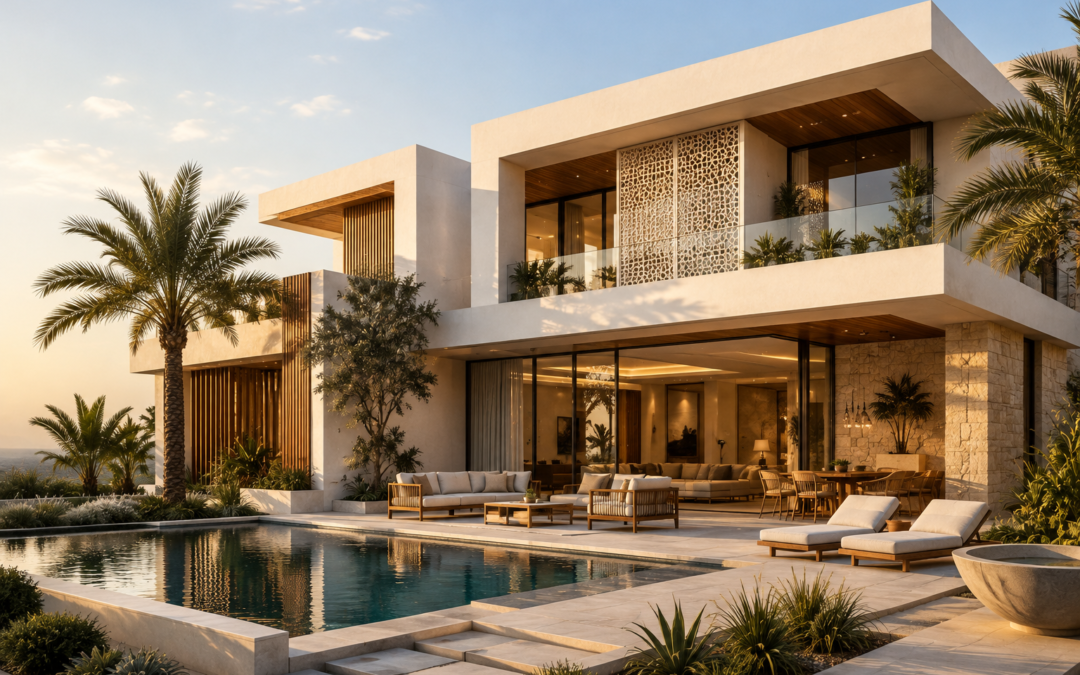
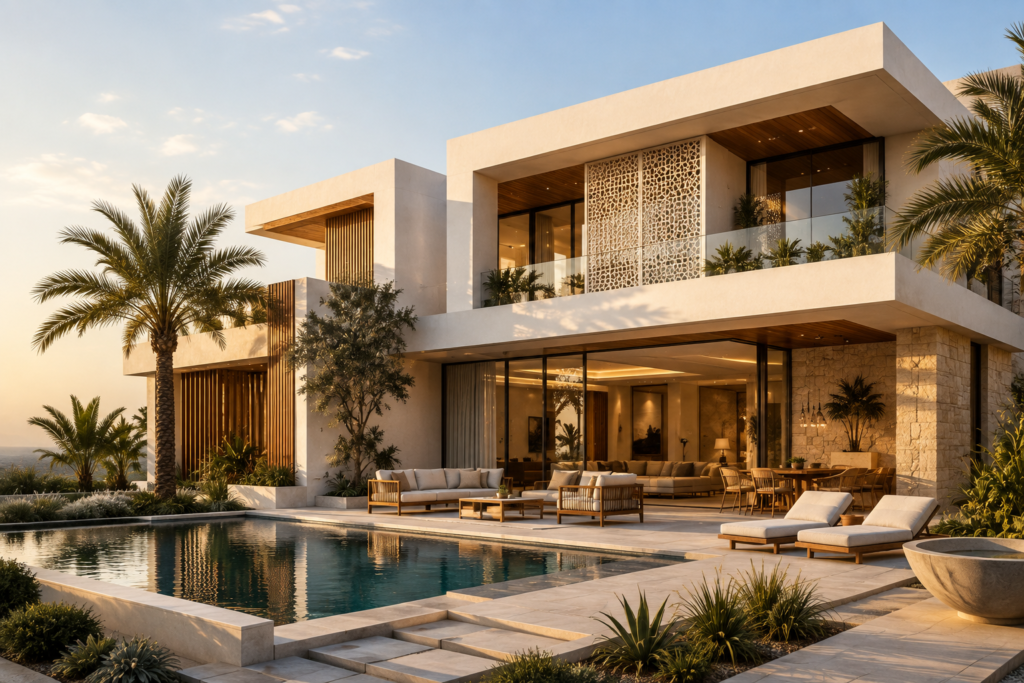
Modern villa design in the UAE is about much more than creating an impressive exterior. With long summers, intense sunlight and high cooling requirements, a successful villa needs to respond intelligently to its environment while providing the comfort and visual character expected from contemporary luxury living.
This is why some of the most relevant trends in modern villa design in the UAE combine architecture, sustainability and technology rather than treating them as separate considerations.
From shaded façades and courtyards to high-performance glazing and smart home systems, today’s villas can be designed to feel open and connected to the outdoors without ignoring the realities of a hot climate.
Here are some of the key design approaches shaping contemporary villas across the UAE.
1. Climate-Responsive Architecture Comes First
One of the biggest changes in luxury residential architecture is a stronger focus on designing for the site and climate from the beginning.
Before deciding how a villa should look, architects can study factors such as solar orientation, prevailing winds, surrounding buildings and the way different areas of the property will be used throughout the day.
A well-planned orientation can help limit unnecessary solar heat gain while still allowing desirable natural light into living spaces.
This is particularly important in the UAE, where simply increasing the amount of glass does not necessarily create better architecture.
The objective is to balance views, daylight, privacy and thermal comfort.
Designing around the sun
Windows and openings can be positioned according to orientation rather than applied uniformly across every elevation. Architectural projections, screens and recessed glazing can then provide additional protection where solar exposure is strongest.
This creates a villa that responds to its location rather than relying entirely on mechanical cooling.
2. Deep Shading Becomes Part of the Architecture
Shading is increasingly being treated as an architectural feature rather than an afterthought.
Deep roof overhangs, balconies, pergolas, recessed windows and vertical screens can reduce direct sunlight while adding depth to a façade.
For luxury villas, these elements can also establish a distinctive architectural identity.
Instead of a completely flat elevation, layers of solid surfaces, shadows, screens and openings create visual interest throughout the day.
Parametric and computational design can take this further by developing custom shading systems according to solar exposure, desired privacy and the architectural language of the project.
3. Courtyards Are Returning to Contemporary Villas
Courtyards have a long history in architecture across hot and arid regions, and their principles remain highly relevant to contemporary UAE homes.
A modern courtyard can provide a private outdoor environment at the heart of the villa while bringing natural light into surrounding rooms.
Depending on the project, it may incorporate:
- Shaded seating
- Landscaping
- Water features
- Trees and vegetation
- Covered walkways
- Outdoor dining
Courtyards are particularly effective when privacy is important. Rather than opening every major space toward the street, the villa can turn inward toward a carefully designed private landscape.
This combination of traditional climatic thinking and contemporary architecture can create homes that feel both luxurious and appropriate to their environment.
4. Large Windows—But Used More Intelligently
Floor-to-ceiling glazing remains popular in luxury villa design, particularly where homeowners want seamless visual connections between interior and exterior spaces.
But in a hot climate, the specification and positioning of glass matter enormously.
Modern villas can use high-performance glazing, appropriate solar-control strategies and carefully positioned openings to achieve expansive views without allowing excessive heat into the interior.
The surrounding architecture is equally important.
A large glass façade protected by a deep overhang behaves very differently from unprotected glazing exposed directly to the sun.
Good villa architecture therefore considers the window, orientation and shading system together.
5. Indoor-Outdoor Living Is Becoming More Sophisticated
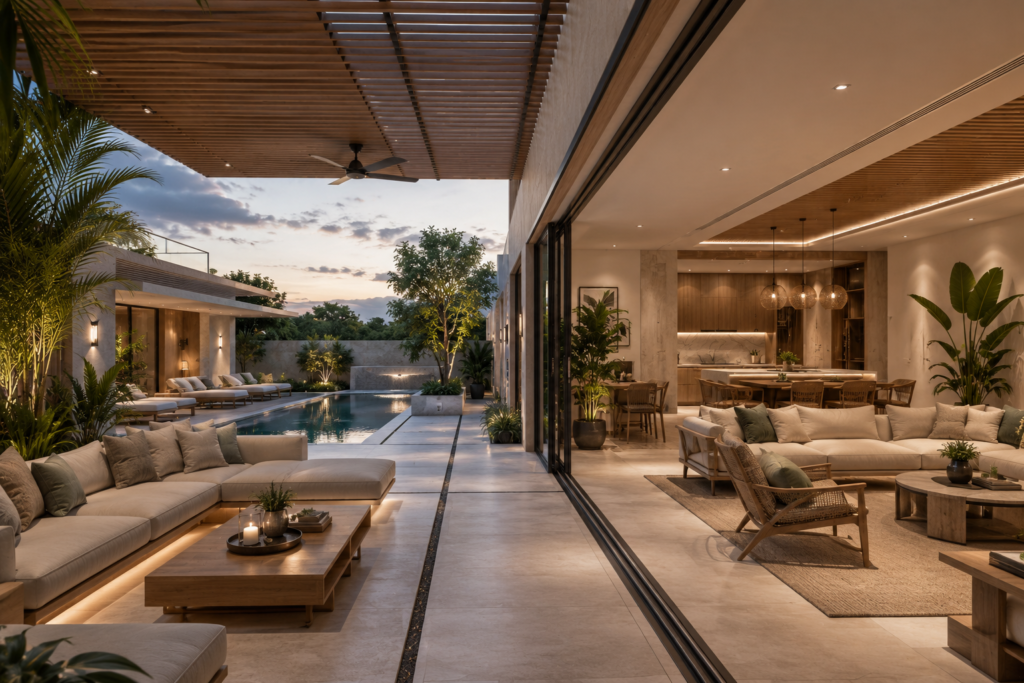
Outdoor living remains an important part of luxury residential design in the UAE, particularly during the cooler months.
Instead of simply placing a terrace beside the house, architects are increasingly creating transitional environments between indoors and outdoors.
These can include:
- Covered terraces
- Outdoor kitchens
- Shaded lounges
- Poolside seating
- Landscaped courtyards
- Retractable openings
- Semi-enclosed entertainment spaces
The objective is to make outdoor areas feel like genuine extensions of the architecture.
Strategic shading and landscaping can also make these spaces comfortable for a greater portion of the year.
6. Natural and Heat-Conscious Materials
Material selection has a major influence on both the character and performance of a villa.
Contemporary UAE villas increasingly combine natural-looking materials with clean architectural forms. Stone, textured plaster, timber-effect finishes, concrete and metal detailing can create warmth without making the architecture visually heavy.
However, materials should not be selected purely for appearance.
Material performance matters
Architects also need to consider:
- Thermal performance
- UV resistance
- Maintenance
- Durability
- Moisture resistance
- Exterior weathering
A material that looks impressive in a rendering but performs poorly under intense sunlight can quickly become a maintenance problem.
Luxury should therefore be measured not only by appearance, but also by how well materials perform over time.
7. Landscaping Becomes Part of the Cooling Strategy
Landscape architecture can contribute to the environmental performance of a villa.
Trees and planted areas can provide shade around terraces, pathways and selected elevations. Carefully positioned vegetation can also soften the transition between architecture and outdoor areas.
At the same time, landscaping in the UAE should consider water consumption.
Climate-appropriate planting, efficient irrigation and thoughtful selection of vegetation can create attractive gardens without unnecessarily increasing resource requirements.
The result is a landscape that supports both the architecture and the environmental strategy.
8. Smart Technology Supports Better Energy Management
Smart home technology is becoming increasingly common in modern UAE villas.
Automated systems can control lighting, air conditioning, curtains, blinds and other building services according to occupancy, time of day and homeowner preferences.
For example, automated shading can reduce solar exposure during certain periods while smart cooling systems can manage different zones according to actual use.
Technology works best when it complements good architectural design.
A poorly designed building does not automatically become efficient simply because smart systems are installed. The strongest results come from combining passive architectural strategies with intelligent building controls.
9. Sustainability Is Becoming Part of Luxury
Sustainability and luxury are no longer opposing ideas.
For many homeowners and developers, a high-quality villa should be comfortable and visually impressive while also using energy and materials responsibly.
A sustainable villa may incorporate better insulation, efficient cooling, solar-responsive architecture, responsible material choices, water-efficient landscaping and renewable energy technologies where appropriate.
These decisions can potentially improve comfort and reduce long-term operating requirements while creating a home that is better prepared for the future.
10. Personalisation Is Replacing Generic Luxury
Perhaps the most important modern villa trend is a move away from one-size-fits-all luxury.
Homeowners increasingly want residences designed around their lifestyle.
One family may prioritise large social spaces and entertainment areas. Another may require greater privacy, dedicated workspaces or multi-generational living.
Successful architecture begins by understanding these differences.
Technology, parametric design and advanced visualisation can help architects explore possibilities, but the final design still requires human judgement and a genuine understanding of how the client wants to live.
Designing Modern Villas for the UAE
The best modern villa design in the UAE is not defined by a single façade style or trend.
It comes from balancing several priorities: climate, comfort, privacy, aesthetics, functionality and long-term performance.
Features such as courtyards, intelligent shading and passive environmental strategies are not new ideas. What is changing is the ability to combine these proven principles with contemporary materials, computational design, advanced modelling and smart building technology.
That creates an opportunity to design villas that are distinctly modern while remaining appropriate for the UAE’s climate and way of life.
How ZFA Studio Approaches Villa Design
At ZFA Studio, we approach residential architecture as a combination of creativity, technology and practical design thinking.
Our capabilities across architecture, interior design, computational and parametric design, 3D visualisation, product design and digital fabrication allow us to consider a villa as one complete environment rather than a collection of separate elements.
From early concepts and spatial planning to façades, interiors and bespoke architectural details, the goal is to create homes that respond to the client’s lifestyle while considering the realities of the UAE climate.
Frequently Asked Questions
What is the best villa design for a hot climate?
There is no single ideal style. Effective hot-climate villas typically combine appropriate orientation, shading, insulation, high-performance glazing and carefully planned outdoor spaces.
Are large glass windows suitable for villas in the UAE?
Yes, but glazing should be selected and positioned carefully. Solar exposure, glass performance and external shading should all be considered together.
Can a modern villa be energy efficient?
Yes. Passive design, better insulation, efficient building systems, smart controls and appropriate materials can significantly improve overall building performance.
Why are courtyards useful in UAE villa design?
Courtyards can introduce daylight, privacy, landscaping and protected outdoor spaces into the centre of a home while reducing dependence on exposed external areas.
Can ZFA Studio design both the architecture and interiors?
An integrated approach to architecture and interior design helps create greater consistency between the exterior architecture, internal spaces, materials and overall user experience.
Plan Your Villa with ZFA Studio
A luxury villa should do more than make a strong first impression. It should respond to its environment, support the way you live and remain comfortable and relevant for years to come.
Planning a new villa or residential project in the UAE? Contact ZFA Studio to discuss a tailored architectural and interior design solution for your project.